

Learn why home services leads get declined for financing, how to spot the most common credit rejection reasons, and steps to cut costly declines.
This guide focuses on credit declines in home services: when a homeowner applies for a home-improvement payment plan, contractor financing, or a loan to cover a project (HVAC replacement, roof repair, electrical work, plumbing, etc.) and the lender says no.
An example:
A homeowner asks for a quote on a new roof. Your rep prices the job, and the homeowner wants to move ahead. Then their credit isn’t strong enough to get financing approved, and the job is lost. The same thing happens with HVAC, windows, solar, and other remodel jobs.
What a financing decline means (and what it doesn’t)
When a homeowner is declined, the lender is saying the application does not meet its approval rules for that product, at that time. It does not automatically mean that the homeowner is financially irresponsible or that they will be declined everywhere. Different lenders use different rules.
Credit scores matter here. On the VantageScore scale, a score of 600 or below counts as subprime and 601 to 660 as near prime. Homeowners below 600 are the most likely to be declined for a large project loan. Those between 600 and 660 can often still get approved, but usually for a smaller amount, at a higher rate, or through a lender that works with lower scores. That’s why the county analysis below uses 660 as the line to watch.
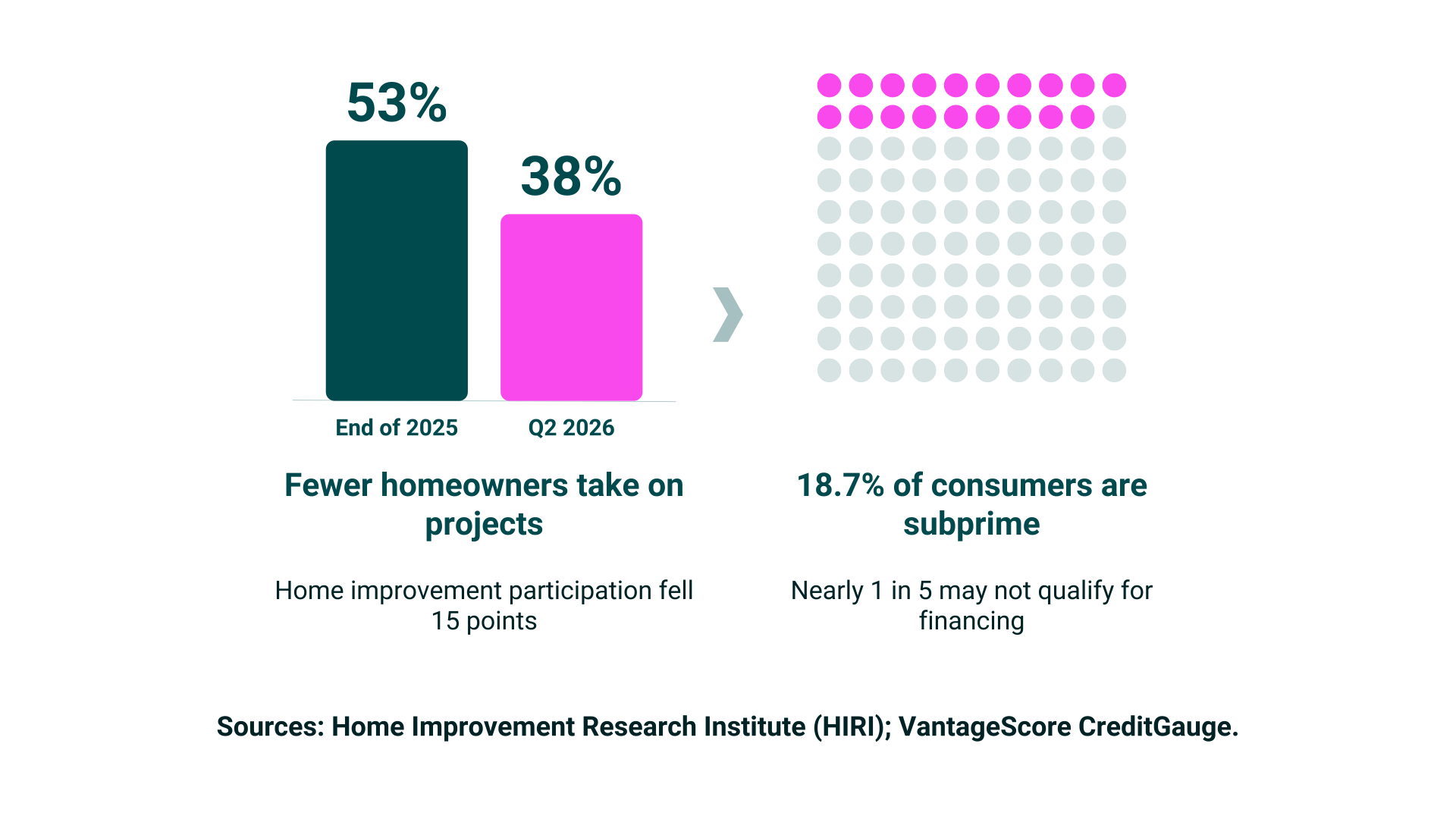
The problem is getting bigger as budgets tighten. Many household budgets are under pressure, and the ability to afford major home improvements is increasingly uneven. According to the Home Improvement Research Institute (HIRI), participation in home improvement activity fell from 53% at the end of 2025 to 38% in Q2 2026. Lower-income households are pulling back faster, while higher-income homeowners continue to account for a larger share of spending.
While overall consumer credit remains relatively stable, nearly one in five consumers ends up in a credit decline.
Why lead buyers miss it
A lead can be rejected for credit at two points: before purchase, when its credit profile falls outside your campaign criteria, or after the appointment, when a lender says no to the homeowner and you’ve already paid for the lead and the visit. The second case costs more, because it directly impacts your gross-to-net sales and wastes your marketing dollars and your sales rep’s time and effort.
Where credit rejects are rising
PX analyzed the share of people with a credit score under 660 across 3,123 U.S. counties, using New York Fed and Equifax data. Nationally, the share barely moved from 2021 to 2026, but it rose in 28 of the 30 largest counties, including Queens, Los Angeles, and San Bernardino. If you sell in large metros, expect more credit declines from the same number of leads.
5 ways to handle home services leads that cannot pay
Big home improvement jobs like roofing, HVAC, solar, and windows run on financing. When more homeowners fall short of lender approval, these are the jobs that stall first. Here’s how to protect them.
Add “can’t pay” as a rejection reason. Split it into two tags: no budget and declined for financing. Send both to your publishers the same way you report sales.
Ask about payment before the appointment. On the confirmation call, ask if the homeowner will pay cash or finance. If they plan to finance, have them apply before the rep visits.
Screen the leads you buy on credit. Add household financial data such as homeownership, income, and credit range at purchase, and set filters for the credit bands your lenders decline. Start with the counties where more homeowners now sit under 660: there, the same lead volume brings more declines. One top home-improvement lead buyer did this and cut financing declines from 28.1% to under 20%.
Match the offer to the market. Where credit is tighter, add a financing partner that approves lower credit scores, price a smaller repair next to the full replacement, and offer a cash price.
Follow up when something changes. Tag every can’t-pay lead and reach out again by email or text when you add a financing partner or run a promotion. Judge sources over 60 to 90 days, since these leads take longer to close.
How PX helps home services companies cut credit rejections
The PX marketplace connects home services lead buyers with leads for roofing, HVAC, window, solar, and remodeling from 600+ publishers.
PX screens for credit at the campaign level, before you buy the lead. You choose the credit signals and ranges that match what your financing partners approve, then pay less for, or skip, the bands that keep getting declined. When financing declines come back through your disposition data, you can see which lead sources send homeowners who can pay for the job. Publishers understand why a lead was rejected, so they send you more homeowners who can get approved.
Some financing declines are part of any big home improvement job. Paying for the same ones again and again, from the same credit bands and sources, is the part you can control.
Our team can show you how credit filters would change your lead volume, booked jobs, and cost per acquisition.
Frequently Asked Questions
1) What does it mean when a home services lead is rejected for financing?
It means the homeowner’s application did not meet a lender’s approval rules for that product at that time. It does not always mean the homeowner is financially careless or that every lender would reject them. Different lenders use different standards, so one financing partner may say no while another still says yes.
2) Why are financing declines so costly for home services companies?
Financing declines are costly when they happen after the appointment. At that point, the company may have already paid for the lead, confirmed the visit, sent a rep, and prepared a quote. If the homeowner wants the project but cannot get financing, the job may be lost even though the sale looked strong.
3) Why should companies track “can’t pay” separately from “not interested” or “no sale”?
Tracking can’t pay separately helps companies see if a lost job came from no interest, no budget, or a financing decline. Without that split, financing problems can look like poor lead quality. Better disposition data also helps buyers and publishers spot which sources bring in homeowners who can afford the work.
4) How can lead buyers reduce financing declines before buying a lead?
Lead buyers can use credit and household data at the campaign level, such as homeownership, income, and credit range. By matching those signals to the credit bands their financing partners approve, buyers can pay less for, filter out, or avoid lead groups that are more likely to be declined.
5) What should companies do with leads that cannot pay right now?
Companies should tag those leads and follow up later when conditions change, such as when a new financing partner is added, a promo is live, or a smaller job is a better fit. Since these leads can take longer to close, this guide recommends judging sources over a 60-to-90-day window instead of only looking at immediate sales.

Ready to take the lead?
Tell us a bit about your request and we’ll route it to the right team.