

A lead marketplace connects many lead sellers with many buyers on one platform. Learn how it works, how pricing is set, and what to look for before you buy.
What is a lead marketplace?
A lead marketplace is a platform where many lead sellers offer consumer inquiries, such as web form leads and phone calls, and many lead buyers compete to purchase them. The platform sits in the middle. It checks each lead, matches it to buyers whose filters fit, runs the pricing, and delivers the lead to the winning buyer, usually within seconds.
You may also see the terms "lead exchange" or "lead distribution platform." They describe the same basic model.
How does a lead marketplace work?
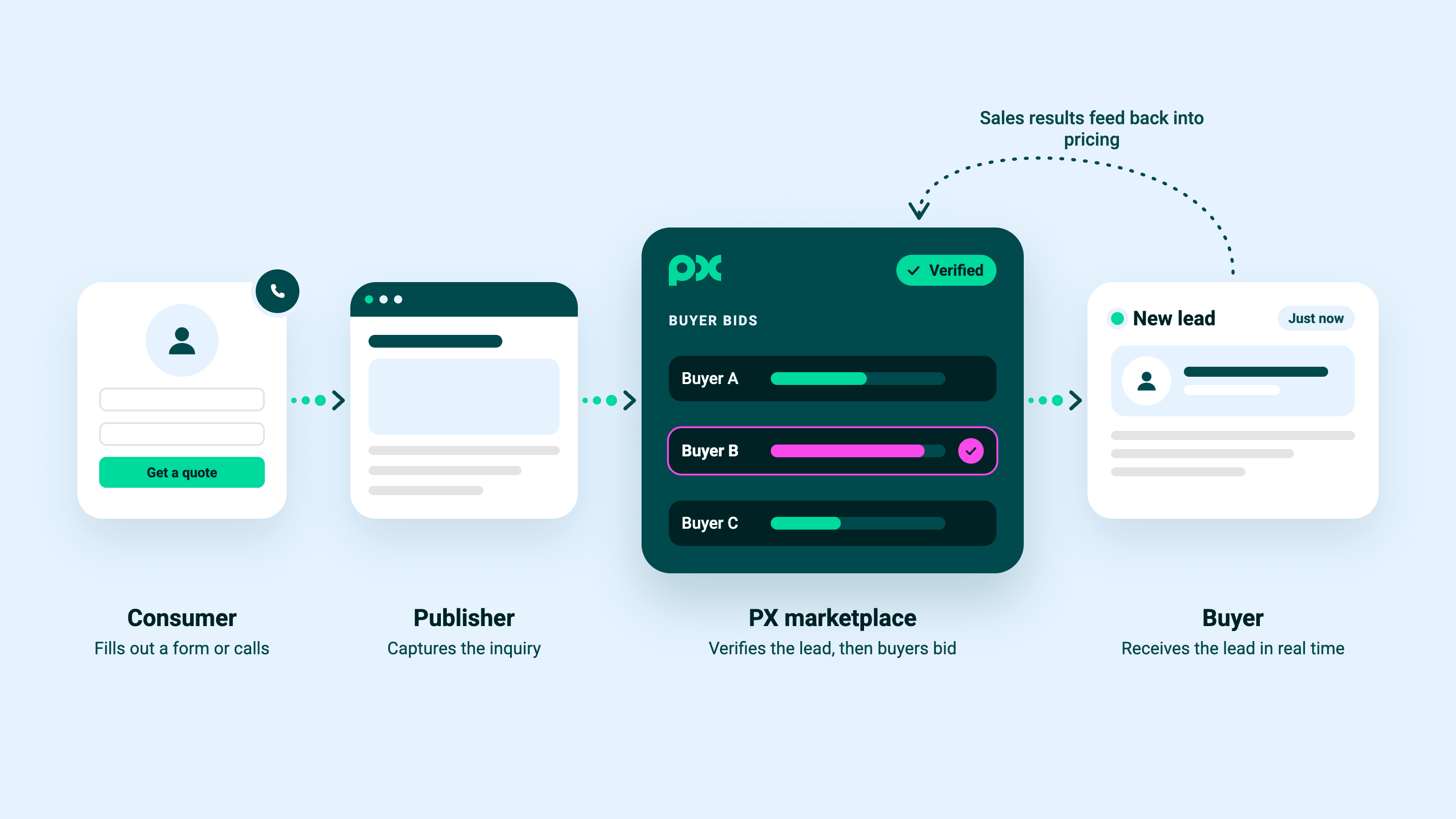
Every lead follows roughly the same path from the consumer to your sales team.
A consumer asks for help. Someone fills out a quote form, clicks an ad, or calls a number about a product or service, such as auto insurance or a new roof.
A publisher sends the lead to the marketplace. The website, call center, or affiliate that captured the inquiry passes it to the platform.
The platform checks it. Verification looks at the phone number and other contact details, confirms consent, and screens duplicates before any buyer sees the lead.
Buyers bid. The platform shares non-identifying details with buyers whose filters match (location, product, lead type). Each buyer's rules decide whether to bid and how much. This step is often called ping post.
The winning buyer receives the lead. It lands in their CRM or call center, usually in real time.
Results flow back. Buyers report what happened to each lead (contacted, quoted, sold), and that data shapes how sources are scored and priced over time.
Who takes part in a lead marketplace?
There are three roles:
Buyers (advertisers): Insurance carriers and agencies, home services companies, schools, healthcare providers, and others who want new customers. They set budgets, filters, and bids.
Sellers (publishers): Comparison sites, content publishers, call centers, and affiliates that generate consumer inquiries and sell them.
The platform: The marketplace itself, which vets sellers, runs verification and pricing, delivers leads, and reports on results.
Lead marketplace vs. a single lead vendor
Many buyers start with one or two lead vendors. A marketplace changes a few things at once.
Single lead vendor | Lead marketplace | |
Sources | One company's traffic | Many publishers in one place |
Pricing | Usually a fixed price per lead | Set by bidding, often adjusted by source quality |
Source visibility | Often limited | Performance by publisher and Sub-ID |
Contracts | One contract per vendor | One integration and agreement covers many sources |
Adding volume | Find, vet, and integrate a new vendor | Turn on more sources within the same platform |
The biggest practical difference is choice. With a single vendor, when quality drops, your options are to negotiate or leave. In a marketplace, you can pay less for weaker sources, pay more for strong ones, and switch sources off entirely.
Why do buyers use a lead marketplace?
Buyers usually move to a marketplace for one of four reasons.
To add volume without adding vendors. When a campaign needs more leads, a marketplace can open new sources inside the same platform, with no new contract or integration.
To test new sources cheaply. Buyers can switch a source on a small budget, watch how it performs, and scale it up or switch it off based on results.
To pay according to quality. Bidding by source means strong sources earn higher bids and weak sources cost less, which keeps budget moving toward the leads that close.
To keep compliance in one place. Vetting, consent checks, and records sit with the platform, so buyers are not managing a separate compliance process for every vendor.
The tradeoff is that a marketplace rewards active management. Buyers who review source performance, adjust bids, and feedback on sales outcomes get the most from it.
What can you buy in a lead marketplace?
Most marketplaces offer several lead types:
Web leads: Form submissions with contact details and answers to qualifying questions.
Inbound calls: Consumers calling live, routed to your phone lines.
Clicks: Visitors sent to your website or landing page, priced per click.
Aged leads: Older inquiries, usually 30 to 180 days old, sold at a lower price.
How does pricing work in a lead marketplace?
Some marketplaces sell leads at a set price. Most use bidding, where each buyer sets what they will pay and the platform matches leads to bids in real time. In a typical ping post setup, the platform sends a short description of the lead (the ping), buyers respond with bids in milliseconds, and the full lead goes to the buyer the rules select (the post). That buyer is usually the highest bidder, though filters, caps, and exclusivity rules can change the outcome.
The better marketplaces go a step further and price by source quality. A lead from a source that closes often is worth more than one from a source that rarely does, so buyers can bid higher for strong sources and lower for weak ones. Tools like programmatic bidding automate those adjustments against your cost targets.
What to look for in a lead marketplace
Before you commit to the budget, check out four things.
How sources are vetted. Ask how publishers are approved and what compliance checks run on each lead, including consent and Do Not Call scrubbing. Lead verification services can add extra layers.
How much can you see. You should be able to see performance by publisher and by Sub-ID, so you know which sources earn their price.
What control do you have. Look for filters (location, product, lead type), bid rules, daily caps, and a clear policy for returning invalid leads.
Whether reporting reaches sales. Cost per lead only tells part of the story. The platform should let you connect leads to closed customers, so you can see which lead sources actually drive sales.
Buying leads on the PX marketplace
The PX marketplace connects buyers with 600+ lead vendors across 30+ industries. Buyers get inbound calls, web leads, clicks, and aged leads through one integration, with verification, source-level reporting, and pricing that adjusts to what each source is worth.

Ready to take the lead?
Tell us a bit about your request and we’ll route it to the right team.