

Disposition data shows what happened to a lead after delivery. Learn what it includes and how lead buyers use it to price, cut, and scale sources.
Quick answer
Disposition data is the record of what happened to each lead after it was delivered: whether the lead buyer reached the consumer, quoted them, sold them, or returned the lead. When lead buyers share it, mapped to the source each lead came from, both sides can see which traffic turns into customers and price it accordingly.
A lead leaves the marketplace, lands in your CRM, and your team takes it from there.
Your team calls, quotes, and either closes the sale or moves on. Each result gets logged in your system.
In most cases, that’s where it stays. The publisher who sent the lead never finds out how it performed, and your next round of bids is set without that information. That logged result is called disposition data, and sharing it changes how leads get priced on both sides.
What is disposition data?
Disposition data is the record of what happened to a lead after it was delivered: whether it was contacted, qualified, quoted, sold, or returned. It’s also called lead disposition, disposition feedback, or conversion data. Call centers use the same word for the code an agent logs at the end of every call. In lead generation, those codes travel back from the lead buyer to the platform and the publisher, attached to each lead.
Dispositions become useful at scale once they’re matched to where each lead came from. On a marketplace, every lead carries a lead ID and a sub-ID, a tag that identifies the specific campaign, page, or placement inside a publisher’s traffic. Matched to those IDs, dispositions show which part of which publisher’s traffic produced each outcome.
Why does disposition data matter?
When you buy a lead, the only number you can see is the price. Cost per lead tells you what you paid. It tells you nothing about whether the consumer picked up, booked an appointment, or bought.
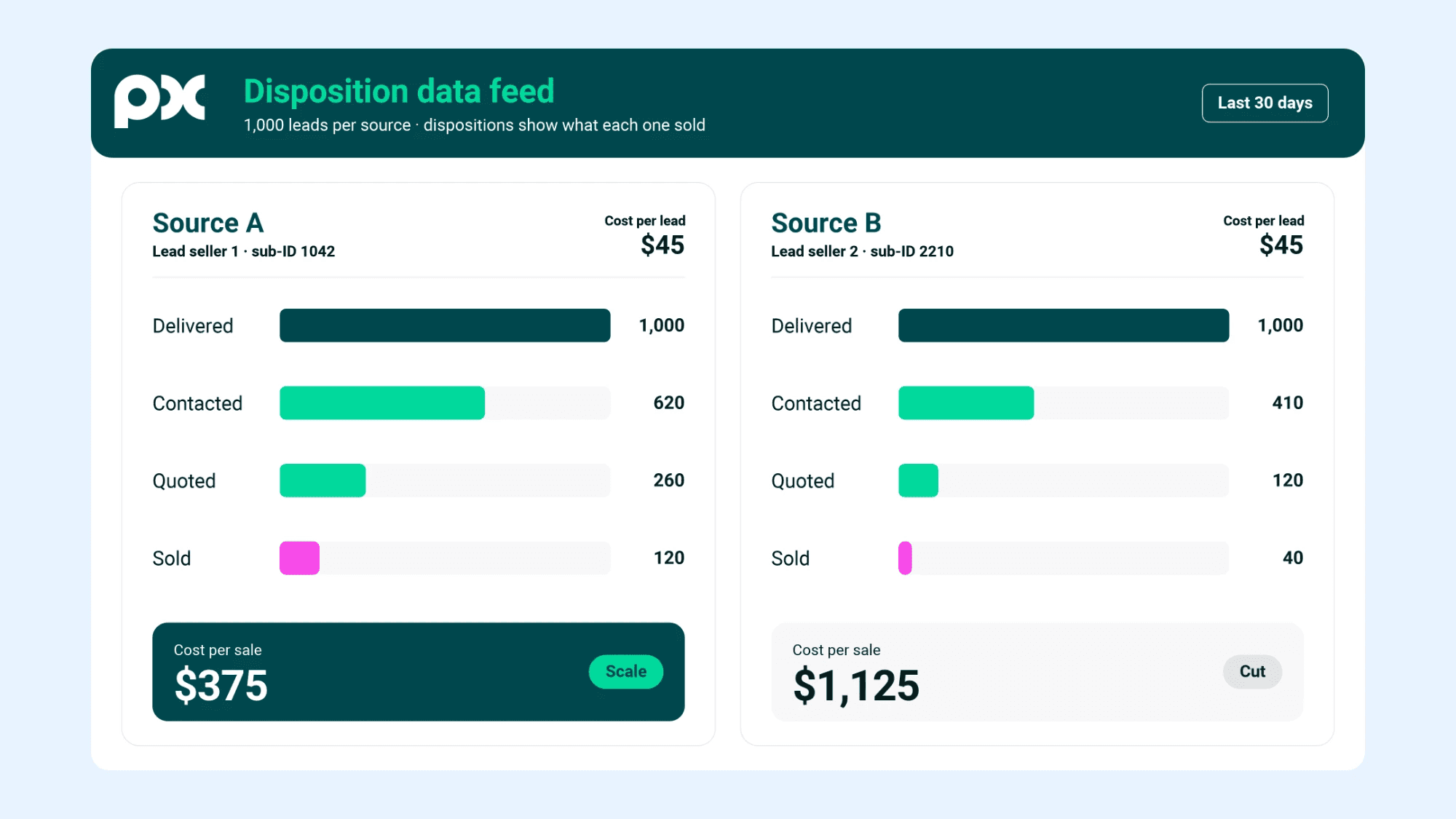
That gap matters because two sources can charge the same price and deliver very different results. Say Source A and Source B both cost $45 a lead. If 120 of every 1,000 Source A leads become sales and only 40 of 1,000 Source B leads do, you’re paying $375 per sale from Source A and $1,125 per sale from Source B. On a cost-per-lead report, the two look identical.
The same gap shows up across the industry. In PX’s State of the Industry Survey, 28% of lead buyers said they are missing their ROI targets by 1x while 88% of publishers said they believe they are helping lead buyers hit their goals. The two sides are looking at the same leads from opposite ends of the funnel: publishers see the lead they delivered, and lead buyers see whether it turned into revenue.
What can lead buyers do with disposition data?
Price on outcomes. With sales tied to each source, dynamic pricing and programmatic bidding can raise bids on the sub-IDs that sell and lower them on the ones that don’t.
Cut with precision. When one campaign or sub-ID drags down a publisher’s numbers, you can pause that sub-ID and keep the rest running. Source management works at that level.
See where revenue comes from. Rolled up by source and sub-ID, dispositions answer the question most lead buyers struggle with: which lead sources drive sales.
What can publishers do with disposition data?
Spend more on the traffic that sells. Dispositions show which campaigns, pages, and placements produce customers, so a publisher can put more spend behind them.
Fix problems at the source. A run of “bad contact data” or “not interested” codes on one sub-ID points to a form, page, or traffic source that needs work. A return with a reason code shows exactly which check a lead failed.
Earn more for the leads that convert. In a ping post auction, lead buyers bid lead by lead. When dispositions show a sub-ID produces customers, lead buyers have a reason to bid more for it.
What is a disposition code?
A disposition code is the label for a single outcome. The term comes from call centers, where an agent logs a code at the end of every call to record the result. Lead buyers use the same idea, and the most common codes cover each stage a lead can reach: bad contact data (the phone number or email didn’t work), no contact (the consumer never answered), contacted but not interested, appointment set or quoted, sold, and returned (the lead failed your quality criteria, logged with a reason code).
What counts as a sale depends on the vertical. In insurance, “sold” usually means a bound policy. In home services, it’s a booked or completed job. In higher education, it’s an enrolled student. The codes before that point (no contact, quoted, appointment set) work much the same way across all of them.
How do lead buyers send disposition data?
Most lead buyers send dispositions in one of three ways:
API or postback: the buyer’s CRM sends each outcome automatically as it’s logged.
CRM integration: a direct connection between the buyer’s CRM and the platform syncs outcomes on a schedule.
File upload: the buyer exports outcomes from their CRM and uploads them in a batch.
Speed matters as much as method. Pricing and campaign optimizations can only adjust to an outcome once it arrives, so dispositions sent the same day shape tomorrow’s bids, while a monthly upload leaves weeks of bids set on old information. PX recommends sending dispositions at least once daily.
Only 7% of lead buyers said they share disposition data daily, and only 9% of publishers said they receive it daily.
How PX handles disposition data
On PX, lead buyers can send disposition data in an automated way back through the marketplace, where it’s matched to the source and sub-ID of every lead. Your reporting shows outcomes and the sales funnel by sub-ID, your pricing rules adjust to them, and publishers see how their own traffic performed.
Every lead you buy already ends with a disposition. Your team records it the moment the call ends. Sent back, it becomes the signal your next round of bids is built on.
If you want to see what your own disposition data could show about your sources, our team is happy to walk you through it.

Ready to take the lead?
Tell us a bit about your request and we’ll route it to the right team.