

A fixed-price lead costs the same whether the homeowner answers on the first ring or never picks up at all. Fixed-price home services leads can look predictable on paper. But once you factor in contact rates, booking rates, and close rates, that fixed price can end up costing you much more than expected.
That gap is where home services budgets go. Your cost per lead holds steady all quarter while your cost per booked job climbs.
Why does a fixed price stop matching the job?
A fixed price assumes every lead carries the same opportunity and every lead source performs the same for you. In home services, it does not.
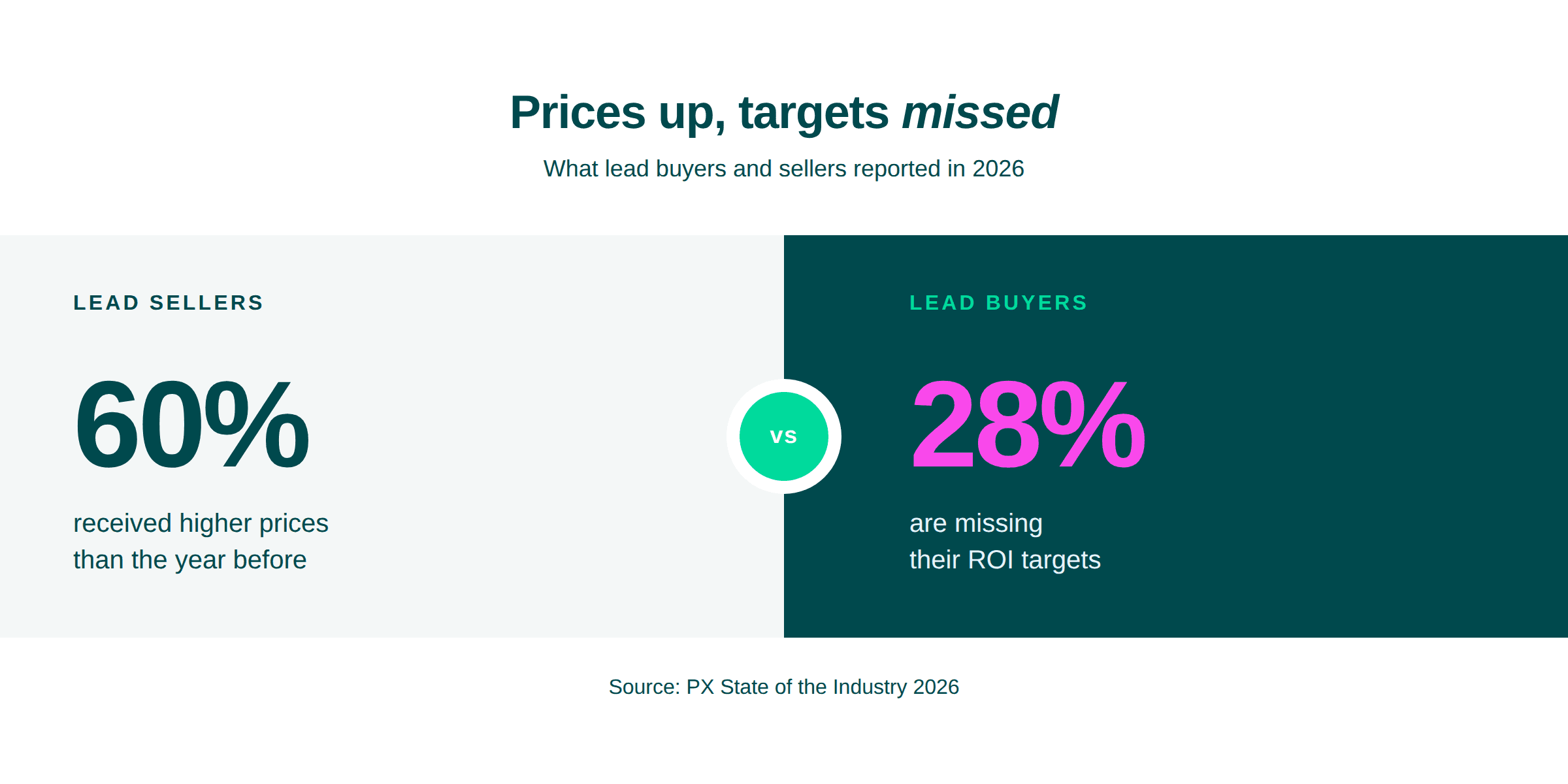
Both sides of the transaction already feel it. In PX's State of the Industry 2026, 60% of lead sellers reported receiving higher prices than the year before, while 28% of lead buyers said they are missing their ROI targets. Prices are moving in one direction and returns in the other.
The price is set once, at delivery. The value is decided across the next ten steps, most of which happen after you have already paid.
What drives the real cost per lead up?
The cost per lead at which you buy is the starting point. The cost climbs as the lead moves through your funnel.
When you never make contact. If the homeowner never answers, you still pay full price for a conversation that didn't happen. How to improve the contact rate of your leads
The homeowner is shopping around. When the same lead goes to several providers, you are competing for the job before you have said a word. See how inconsistent lead quality affects home services marketplaces
The lead was never a real opportunity. Wrong number, homeowner outside your serviceable area, or someone researching a project they will start in eight months. Same price as a ready buyer.
Your speed-to-lead. You call at four. They booked someone at ten. Harvard Business Review's audit of 2,241 companies found that firms contacting a lead within an hour were close to seven times more likely to qualify it than those who waited an hour longer, and more than 60 times more likely than those who waited a day.
The follow-up breaks down. A missed callback, a rushed conversation, one attempt and no second try. The opportunity was there, and the process lost it. Five steps to increase conversions on the leads you already bought
The job value does not match the lead cost. Lead prices are already split hard by trade. WebFX puts high-volume work like plumbing and pest control at $76 to $100 per lead, standard trades at $100 to $264, and premium jobs like kitchens, baths and roofing at $350 to $500. Pay a premium price for a service-call job and the margin is gone before the van leaves.
You are measuring the wrong number. Cost per lead can hold steady for months while cost per booked appointment, sold job, and acquired customer all climb. Find out which lead sources generate sales and how to achieve positive ROI buying internet leads
The tap stays open. If you don't set caps, schedules, and filters around what your team can actually handle, leads keep arriving. Budgets do not slow down on their own when the calendar is full.
How do you bring your overspending on leads down?
Start with the changes that cost nothing.
Tighten your service area and trade filters so you stop paying for jobs your team cannot take. What third-party filters can do for control
Set a five-minute first-contact target and hold the team to it. If you're not operationally ready, add an AI outbound agent.
Have AI agents review your sales call transcripts and count the workable opportunities lost in the conversation.
Dispute invalid leads instead of absorbing them. If a lead source keeps failing the math, pause it.
Then separate your budgets by job type. Replacement leads and service call leads have different economics, so they should stop competing for the same money.
Why not just pay per booked job?
It is the obvious question. If the value sits in the outcome, pay for the outcome.
Pay-per-sale moves the risk onto the seller, and sellers price risk. You pay a premium per job, you work with fewer sellers because not many will take that deal, and you spend time arguing attribution, because the seller now has money riding on every disputed close.
The workable version is a price that moves with each lead instead of a payment that waits for the sale. You set the cost per acquisition you need to hit. Each lead is then priced against how likely it is to convert, so a weak lead costs a few dollars, a strong one costs more, and the average lands where your math works. On PX that range can run from around $12 to $78 inside a single campaign. See how dynamic lead pricing works
How does PX help you reduce wasted lead spend?
The goal is to make sure the leads you buy have a real chance of becoming revenue.
PX shows which sources and sub-sources produce booked work, so budget follows outcomes instead of volume. Source management is where that gets controlled. You set your service area, trade and delivery hours before a lead is purchased, and verification, deduplication and filters cut waste at the point of purchase rather than at the end of the month.
You can also see how leads are priced and routed before they reach your team.
Make your marketing dollar work harder
See how PX works for home services customer acquisition, then talk to our home services team and book a demo.

Ready to take the lead?
Tell us a bit about your request and we’ll route it to the right team.