
Healthcare





Trusted by


A modern lead marketplace built for scale
Lead marketplace
How can I get more leads?
Add new lead sources and manage existing ones better through a curated lead marketplace
Automation
How do I optimize and improve performance?
Make faster decisions and scale campaigns based on customized KPIs, with automated routing, pricing, and lead source optimization
Fragmentation
How do I deal with so many lead sources?
Centralize onboarding, compliance management, reporting, billing, and integrations in one seamless marketplace
Transparency
Where do my best enrollments come from?
See performance at the source level, understand what drives true enrollment outcomes, and reallocate spend with confidence


How does third-party lead buying work?
1
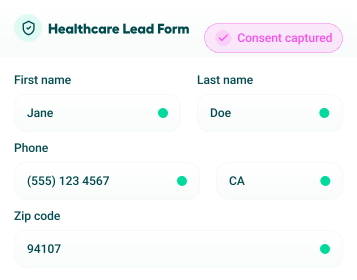
Lead submitted
Consumer completes a compliant form
2

Live auction
Qualified providers bid in real time
3
Agent outreach
The winning provider contacts the lead

Estimate available health insurance lead volume for your enrollment goals
Choose your plan type (Medicare, ACA, and more), states, filters, and volume needs to see how many compliant leads and calls are available.
Compliance management that you can see, trust, and prove
TCPA
CMS
SOA 48-hour ruling
HIPAA
SOC2 Type II
Current state
Fragmented
Separate compliance processes for each lead source
Manual reviews for each lead source slow down onboarding
Reactive rather than proactive publisher monitoring
Desired state
Centralized
Centralize all lead sources under one compliance framework
Have visibility into the end-to-end lead journey
Ensure leads are real-time, human, and not bots filling out the form
PX's retention solution proactively retains at-risk policyholders
30%
of new enrollments switch or exit within the first 90 days
What if you could predict and retain them proactively?
Churn signals detected
Identify early switching signals from PX's marketplace activity and behavioral patterns
At-risk policyholders routed
Route at-risk policyholders to the right retention queue based on your internal workflows
Proactive retention outreach
Your retention team intervenes with the right plan or offer to prevent churn
13x
Outcomes scaled
CPA
Below target levels


Frequently Asked Questions
What are healthcare leads?
Healthcare leads are individuals who express interest in enrolling in a health insurance plan, including Medicare Advantage, ACA marketplace plans, under-65 health insurance, supplemental coverage, or related healthcare services. In regulated markets like Medicare and ACA, healthcare leads must meet specific consent and compliance standards before being contacted by licensed agents.
What is the difference between Medicare leads and ACA leads?
Medicare leads typically involve individuals aged 65+ or those eligible due to disability, often enrolling in Medicare Advantage or supplemental plans. ACA leads refer to individuals purchasing coverage through the Affordable Care Act marketplace, typically under age 65. Each segment has different compliance requirements, enrollment windows, and retention dynamics.
Why is healthcare marketing becoming more difficult?
Costs and compliance pressure are rising at the same time: • Higher cost per acquisition • More competition for high-intent leads • FCC, CMS, and carrier compliance oversight • Seasonal swings during AEP and Open Enrollment • Retention and rapid disenrollment That's why optimizing for cost per lead alone no longer works.
What is compliant healthcare lead buying?
Compliant healthcare lead buying ensures that: • Leads have traceable consent • Consent documentation is recorded and accessible • Do Not Call and suppression lists are respected • Marketing practices align with FCC and CMS regulations • Agents contact leads within permitted guidelines • Compliance-first acquisition reduces legal and regulatory risk.
What is sub-ID level transparency in healthcare lead buying?
Sub-ID transparency shows performance at the individual source level, not just a blended cost per lead. You can see: • Performance by publisher, campaign, and traffic type • Win rates for every source and sub-source • Performance by state • ROI by campaign This shows which partners drive approved, retained revenue.
Why is retention important in Medicare and ACA marketing?
In Medicare and ACA markets, revenue depends on approved and retained enrollments. Rapid disenrollment or early policy lapse can significantly reduce lifetime commission value and impact carrier relationships. Optimizing for retention ensures acquisition spend translates into durable member revenue.
What is rapid disenrollment in Medicare?
Rapid disenrollment typically refers to members leaving a Medicare Advantage plan within the first three months of enrollment. High rapid disenrollment rates can negatively impact commission realization and carrier performance metrics. Monitoring early churn helps healthcare brands protect long-term revenue.
How can healthcare brands improve enrollment approval rates?
Enrollment approval rates can be improved by: Sourcing higher-intent leads Ensuring compliance at the lead source Aligning lead flow with licensed agent capacity Using dayparting and pacing strategies Monitoring source-level performance Approval optimization bridges the gap between cost per lead and revenue realization.
What should healthcare marketers measure beyond cost per lead?
Beyond cost per lead, healthcare marketers should track: • Contact rate • Approval rate • Agent response rate • 3- and 6-month retention • Rapid disenrollment rate • Lifetime value per policyholder • Issue rate Measuring beyond CPL provides a clearer picture of true revenue performance.
How does technology improve healthcare lead buying?
Technology enables healthcare brands to: • Automate compliant lead acquisition • Centralize lead vendor management • Monitor performance at the sub-ID level • Align lead flow with operational capacity • Buy leads at the right price based on their value to the business • Optimize for retention and revenue durability


Convert more leads